In this review XtremeHardware tested for you the Phobya liquid cooling system pumps. Produced in three models, DC12-220, DC12-260 and DC12-400, they are ideal to build a liquid cooling system with a modest cost.
[VERSIONE ITALIANA]
In previous years we have seen the introduction in the liquid cooling market of ever more powerful pumps and consequently more noisy, dictated by the need of flows and pressures that can work with increasingly restrictive water block. In the last 2 years, the market has brought about a change of course. Following less restrictive waterblocks and accessories, guaranteeing an equal, if not better, dissipation coefficient of the previous ones, the producers have focused on improving performance in relation to the flow and noise during operation. So new generation pumps have appeared on the market, which vary by type of technology used, power, size and supply voltage.
Pump means a machine tool capable of transferring energy to a liquid. Depending on how this energy transfer takes place, there are two types of pumps:
volumetric pumps (that move constant amount of liquid for each cycle)kinetic pump (due to centrifugal force, the fluid increases its kinetic power that is convertedinto pressure energy. The power output depends on the prevalence)
Another general classification that we can do is:
rotary motion pumps (ie centrifugal, with gears, with capsules, segmented, with membranes, etc.).
which we show the example photos below
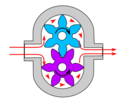
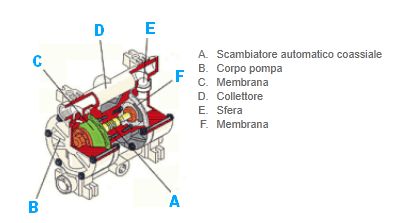
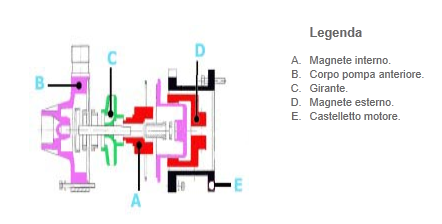
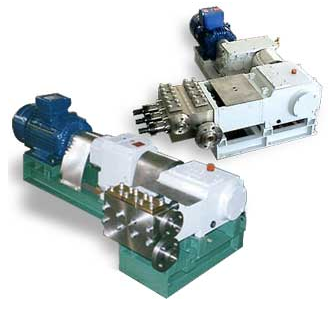
Alternating motion pumps (ie piston, for example)
following is an example
The prevalence term is mainly intended as the maximum height difference that a pump can overcome with a fluid.
The pumps that we will treat now are of rotary type, with blade impeller. In the following paragraph we will go into detail on the technical aspects of the Phobya DC12-220, DC12-260 and DC12-400 pumps series.
Product presentation and content
Phobya, known German manufacturer specialized in products for the PC Cooling industry as well as for modding, has an extensive catalog, of which the leading European retailer is Aquatuning .We can certainly argue, after testing various products, that Phobya is synonymous of quality.

The Phobya is identified with the single triangle avatar with in the interior a figure of a demonic face. This avatar is in perfect agreement with the motto that always accompanies it: "Fear it"; and it is precisely in this phrase that the company is concentrating all its efforts to pursue excellence in making its products with a high technology.That's why the phrase "Fear it"!
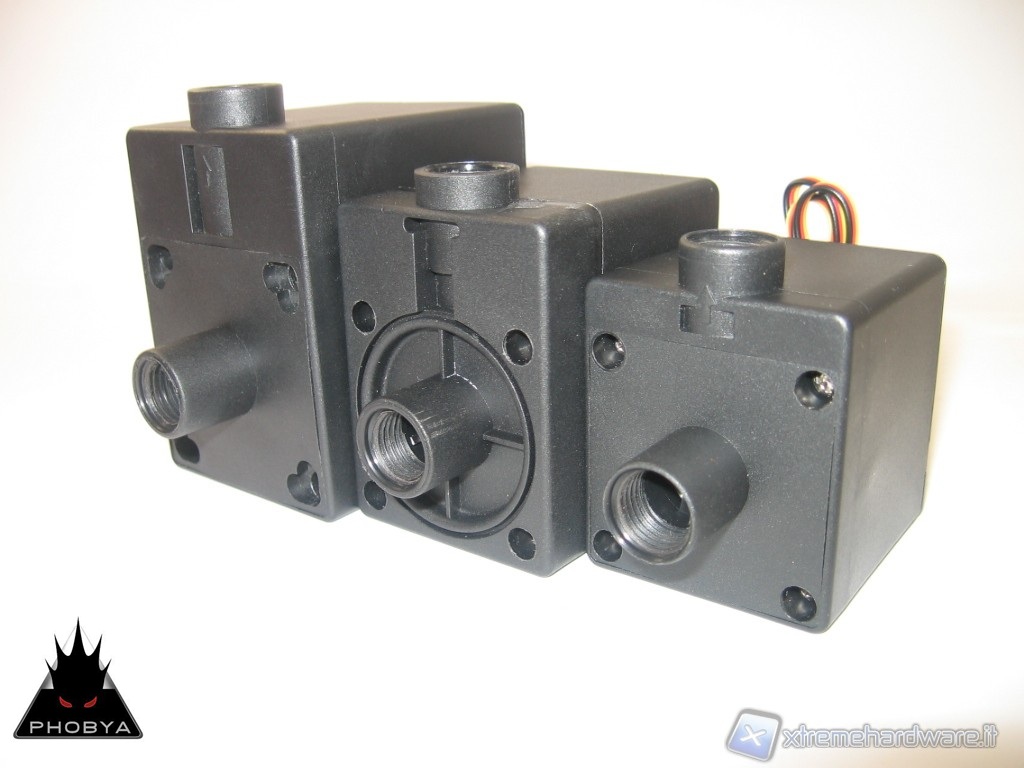
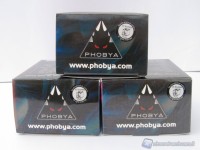
Below we will show you the products that will be tested.


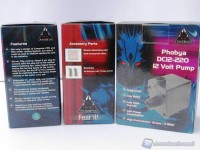

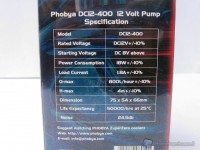
At the back we can see the technical specifications of the pumps that are differentiated by their power and, therefore, for the flow.


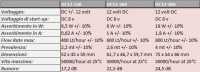
We quote below the comparative Blueprint.
Opening the package we see the usual attention to details, in this case the packaging to protect the pump from possible shocks.
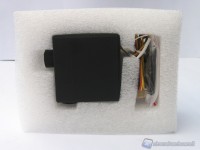
We highlights the comfortable three-wire connector including two for power, while the third is used to carry the rotation index signal. The same three-pin connector allows you to connect the pumps to a Rheobus, after verifying that the same is able to provide adequate amperage. The advantage is that it can vary (decrease) the speed of the pump, so as to make it work at lower speeds when temperatures permit.
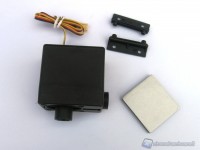
In addition to the pump, in the package are the mounting bracket and an adhesive antivibration pad. The only caution, is to remember to purchase the junctions that are not included.
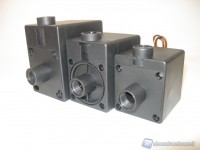
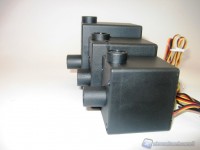
As we can see from the comparison, the pumps are different in size, from smallest DC12-220 to the largest and powerful DC12-400. Regarding the dimensions, please consult the technical-comparative scheme picture posted in the above photos.
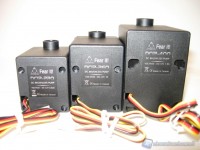
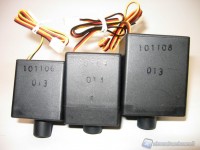
The pumps can be also identified by the model name printed on the back.
We can also note the serial number engraved in each pump, which traces and identifies the product for warranty and quality control before being shipped.
Specifications
As we can see from the images to follow, each pump has 2 holes: one for incoming and one for the exit of the liquid. The center hole is the inlet while the other is the outlet, as indicated with the arrows on them. Both two are ¼ "G threaded holes.
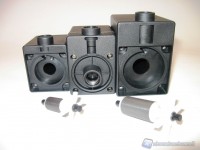
Unscrewing the 4 screws you can remove the cover, exposing the impeller.
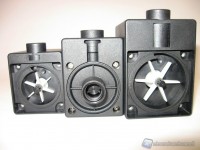
We note that the central pump, DC12-260, still has the lid mounted despite the 4 screws are removed, unlike the other 2 pumps, ie the smallest (DC12-220) and the most powerful of the series (DC12-400). Below is a photo of the detail where you can note the presence, in each pump, of an O-ring that acts as a seal.
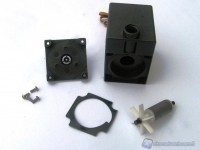
The impeller, held together by a magnetic cylinder, consists of 6 blades. As we see, it is completely removable for periodic cleaning.
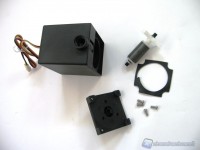
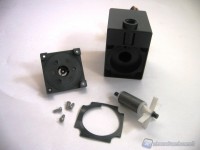
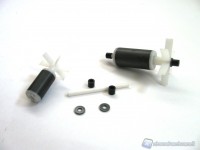
The direction of rotation is counterclockwise, so that the pump pushes the water out. As central axis we find a ceramic pin, with 2 rubber supports at the ends that engage between the lid and the pump body.
The test system and testing methodology
We proceeded to test the 3 Phobya pumps both idle and loaded. In the idle circuit, the pumps were run with the mere presence of the High Flow G1/4" Flow meter of Aquacomputer (appreciated for its low resistance to the liquid and for its precision), linked to the Aquaero 5 XT Controller (to detect the flow).In addition to this we have connected the pump to a simple, but large, bowl to act as a buffer, to have the pump always full of water so as not to create the classic cavitation phenomenon.
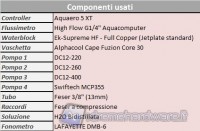
In the full load test we have included after the pump an EK waterblock, the Supreme HF - Full Copper model, with the standard Jetplate, combined upstream the pump with the Phobya radiator, model G-Changer 360 Ver 1.2 Black. We used a bi-distilled H2O solution as liquid mean. Below, in the table, the synthetic summary of the components used for testing.