With Microsoft Windows Vista release and the growing needint to have huge memories quantity in our systems, the DDR2 kit gain more and more commercial values, and we are here to show you the new BALLISTIX TRACERPC2-6400.
The Ballistix Tracer memory kit is well know for its extreme performances and for the spectacular scenic effect that it can make! Are you bored about the usual memory kit? You want something more? Faster and more beatifull…? Well, Crucial thought to you, with a series of product made ad hoc for the “tuning” enthusiast like you!
Anyway, this is not just an aesthetic thing…infact while most memory makers brands are trying to product faster and faster DDR2 kits with always tighter timings, with this kit we are in front of some unusual chips (with performance a lot similar to OCZ PC 8500 SLI edition kit). We still are in front of Micron D9 chips but with different over clock aims! We’ll see…
Let’s see how this kit perform on a Intel Core 2 Duo platform…
A bit of Micron & Crucial History….
Micron Technology, Inc., one of the largest dynamic random access memory (DRAM) manufacturers in the world and the only one based in the U.S. Headquartered in Boise, Idaho, Micron manufactures DRAM chips and assembles them into high-quality memory modules for sale to original equipment manufacturers ("OEMs") worldwide.
For nearly three decades, Micron has learned that when you make some of the very best memory in the world, lots of companies want it, from computer makers to wireless device manufacturers to printer producers.
So in 1996, Micron responded to a growing demand for high-quality memory upgrades among end users who wanted the best possible performance from their systems. Micron launched Crucial Technology in September of that year, and for the first time, end users had the opportunity to buy directly from the manufacturer the same memory modules bought by the world's leading manufacturers for original installation in their systems.
In 1999, Crucial Europe opened for business in Kilbride, Scotland, offering end users outside the U.S. the same benefits of reliability and performance combined with manufacturer-direct savings and convenience.
Demand for Crucial upgrades has grown rapidly since the Crucial Europe launch, and we have expanded our product line to include graphics cards, flash cards and readers, and USB flash drives.
Unlike other memory sellers, we ensure testing for 100 percent of the modules that go out our doors. That's important to customers who need quality-assured memory for mission-critical applications.
The Ballistix series has got the best chip avaible! And all them are tested so they can work at so high frequencies.
Memories Introduction.
The memories shows up in the classic Crucial blister:
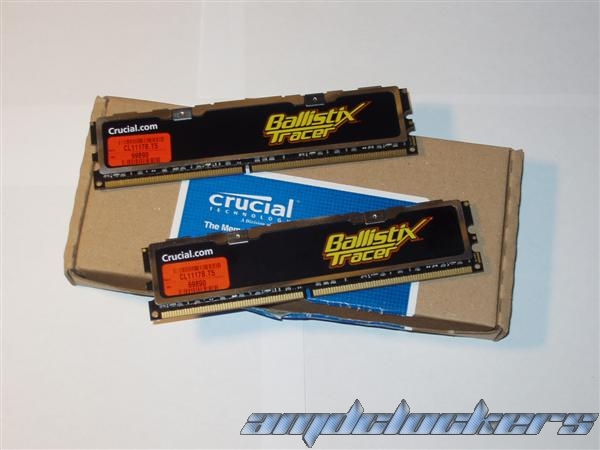
The "Ballistix" memory family is the high end of the Crucial DRAM products.
If you are still not satisfied with the Ballistix, then you should take a look at the new Ballistix Tracer, the best and the most beautifull memory kit you can find in all the Crucial products. :
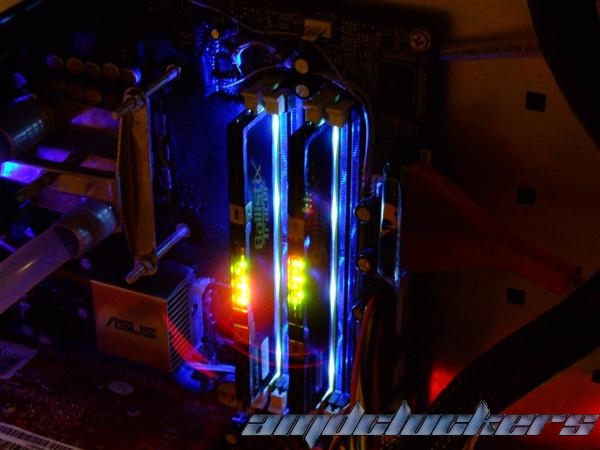
All the modules are equiped with black aluminum passive heat-spreader kept toghether with an adesive themical pad. On the heat spreader we can find the classic Ballistix logo that let us see the two different colord LEDs rows (red and yellow) that lights up in a different way for each status. We can find a blu LED row that lights up the mainboard PCB with a fantastic light blue light!!!! Just an awesome aspect for the modding enthusiast.
The PCB is a normal 6 layers pcb used by every memory maker for high-end products
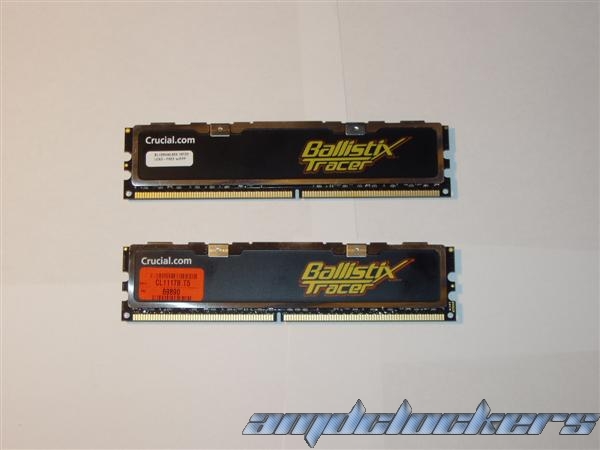
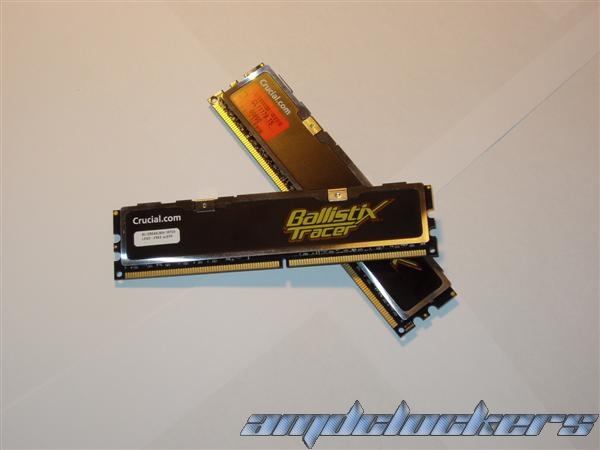
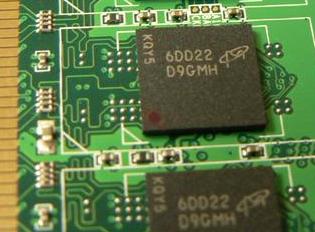
The memories are equipped by Micron D9 GMH chip.
Here is the constructor characteristics:
| Ballistix Tracer PC2-6400 | |
| Opeative Frequency | 800 MHz DDR2 |
| Timings | CL 4-4-4-12 (CAS-TRCD-TRP-TRAS) a 2.2 volt |
| Modules | Memory Modules 128M x 64-bit 1GB (1024MB) DDR2-800 CL4 SDRAM (Synchronous DRAM), on a 16 64M x 8-bit DDR2 FBGA Component per module 2GB KIT (2x1 GB) optimized for Dual Channel |
| Features | SLI Ready, UNBUFFERED, NON-ECC |
| Volts Range | 2. 2v |
| Price for a 2x1GB kit | 350-360 € |
This kit is guaranteed with the standard PC 6400 JEDEC, DDR2 800 Mhz, with4-4-4-12 timings, without the need of high voltage, since we can find 2.2v on every ddr2 mainboard. But we’ll see this kit will reach a lot higher frequencies!
System Config and Test methodologies.
We used an Intel 965 chipset based mainboard with an Intel Core 2 Duo Conroe e6600 to test this memory kit.
The tests were made with Microsoft Windows XP SP2 fully updated with the last patches and without any optimization.
| Intel Platform | |
| Cpu | Core 2 Duo E6600 |
| Mainboard | Asus P5B De Luxe bios 0804 |
| Chipset | Intel 965 |
| Memory Kit | BALLISTIX TRACER PC 6400 Dual Channel 4-4-4-12 a 2.2v |
| Video Card | Sapphire X850XT su bus PCI |
| Hard Disk | HD WD Caviar Special Edition 80 GB PATA 100 with 8 MB buffer |
| Cooling | Liquid Cooled By OCLABS MB-6E + eheim 1250 |
| PSU | Thermaltake ThoughPower 750 watt |
| OS | Windows XP Professional SP2 |
| Benchmarking Tool | CpuBench (memory score) Sciencemark 2.0 (memory test) SiSoft Sandra 2007 (Memory Bandwith and Cache & Memory) SuperPI mod 1.5 2M, 32M 3DMark2005 |
| Tools used | Clockgen 1.0.5.0 Cpu-z ver. 1.38 |
| Test Frequencies and voltages | CPU with 9x multiplier in all the tests. Synthetics Benchmark with 2.2v e frequencies/timings: · DDR2 533 with 3-2-2-4 · DDR2 667 with 3-3-2-4 · DDR2 800 with 3-3-3-4 · DDR2 1067 with 4-4-4-4 Maximum Overclock reached for SuperPI 1M and 32M with the following voltages: · 2,25v da bios (2,24 in windows) · 2,45v da bios (2,43 in windows) |
We will make two different kind of tests, made to answer to these two following philosophies:
- the first type of test will be made by testing the memories under a series of benchmarking programs aimed to find the general performances. All the test are made to let at default the CPU frequency (leaving the CPU fsb @ 266MHz) and using the memory multiplier to reach all the frequencies we need. We will have a complete and usefull scheme for the DDR2533/667/800/1067 frequencies.
- A second type of tests will made by applying two different voltage: 2.25v (to simulate a daily use) and 2.45 v (to simulate a benchmark usage, to analyse the behaviour of the kits with higher voltage). SuperPI1 M will be used to find the minimal stability and SuperPI 32 M to find a better stability.
We used a mainboard without vmod and with air cooling, so eberyone will be able to make our test ad home.
Synthetics Benchmark
Leaving CPU at default frequencies (Conroe E6600 9x266=2.40GHz) we made the memory to work at DDR2 533/667/800/1067 frequencies setting the tighter timings possible. All the test were made with 2.2v.
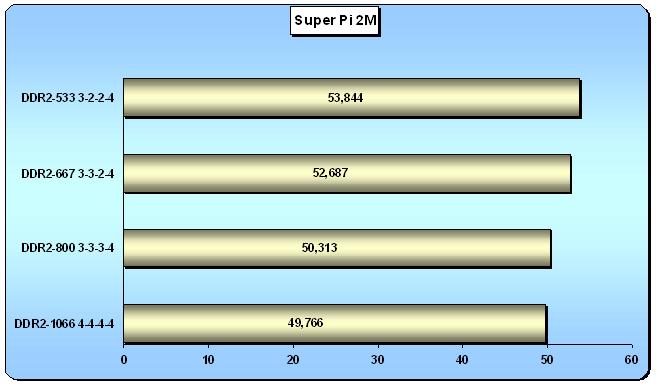
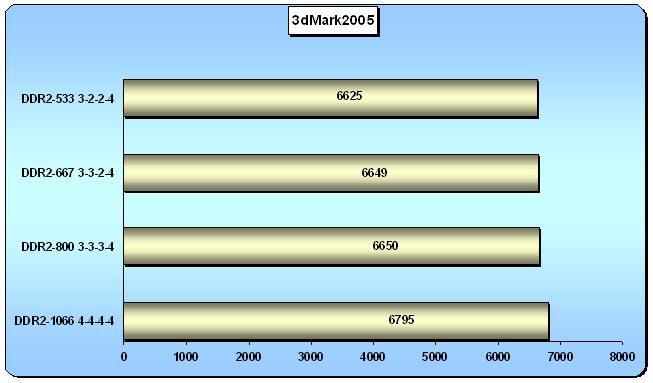
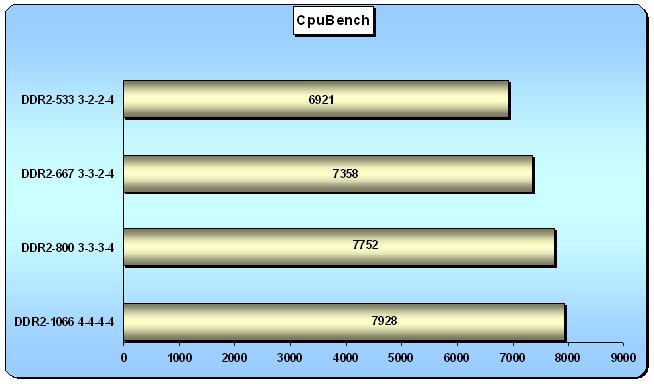
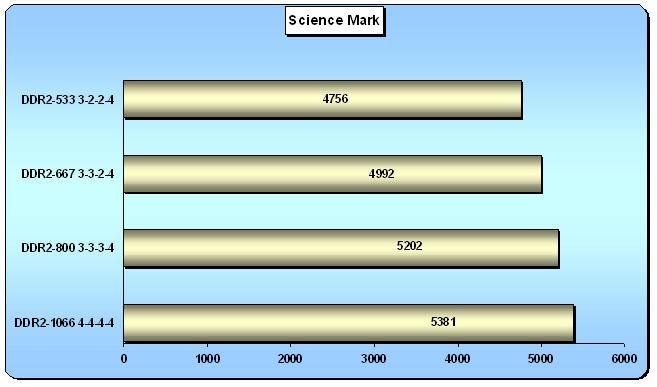
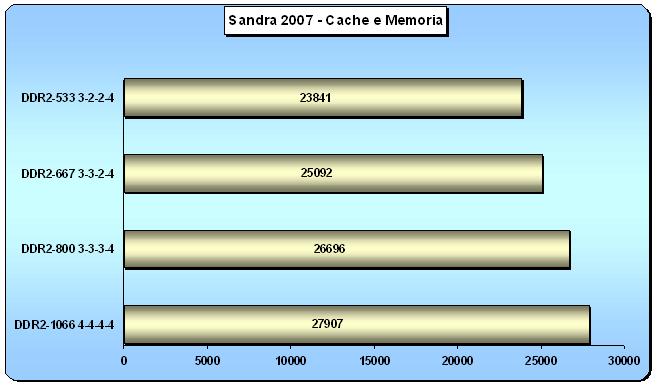
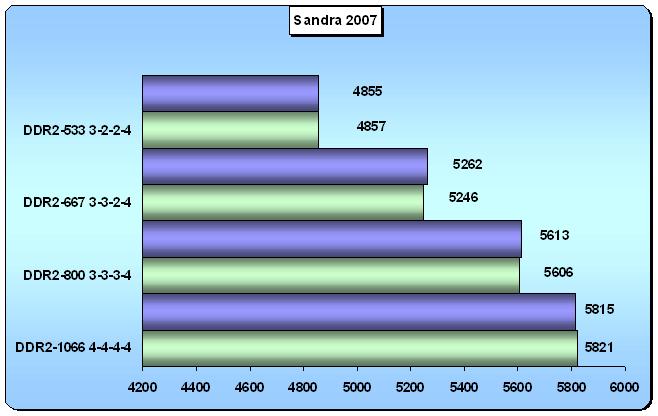
With this type of benchmarking test we can see how raising the working frequencies even with looser timings we can have a lot more bandwidth and better test scores.
The general performance of this kit is pretty good since from DDR2-533 MHz to DDR2-1066 MHz we measured a gain of 20% performance in bandwidth. This is a 10% less in the SuperPI 2M scores.
Test Overclock
This type of tests will made by applying two different voltage: 2.25v (to simulate a daily use) and 2.45 v (to simulate a benchmark usage, to analyse the behaviour of the kits with higher voltage). SuperPI1 M will be used to find the minimal stability and SuperPI32 M to find a better stability.
We used the best memory muultiplier to find out the best memory performance! The Cpu multiplier is locked to 9x.
The start FSB were set up in the BIOS, while in windows se grew up the frequencies with Clockgen or SetFSB. All the timings were set in the BIOS.
The following tests in the graphic shown are obtained starting from the bios with 266 MHz FSB and memory multiplier at FSB:RAM=1:1

The following tests in the graphic shown are obtained starting from the bios with 266 MHz FSB and memory multiplier at FSB:RAM=2:3

The following tests in the graphic shown are obtained starting from the bios with 266 MHz FSB and memory multiplier at FSB:RAM=2:3

The following tests in the graphic shown are obtained starting from the bios with 333 MHz FSB and memory multiplier at FSB:RAM=2:3.

The following tests in the graphic shown are obtained starting from the bios with 400 MHz FSB and memory multiplier at FSB:RAM=2:3.

This kit has an excellent performance within all the frequencies range we tried on.
These memories can work from DDR2-664 MHz with timings 3-3-2-4 with 2.2v till DDR2-686 Mhz with just 2.45 v. And they can handle a 32M SuperPI with timings 3-3-3-4 till DDR2-840 with just 2.43v in windows.
While with default timings, with 2.25v we gained 87MHz that become 110MHz with only 2.45v! Just awesome!
The apotheosis is reached with timings 5-5-5-15 and 2.43v in window where this kit can close a 1M SuperPI at DDR2-1304 and a 32M SuperPI at DDR2-1260.
We didn’t have anymore benefits in raising the voltage till 2.7v, we only reached the 1330MHz ddr2 frequency, but it was just a 1M superpi.
Don’t use voltage as high as we did in daily use. It will cause the death of the memory kit. Use always a 80x80mm fan on the memories to pull out the heat that they produce.